The UK electric tractor market is small but no longer theoretical. A handful of battery-electric machines can be ordered through established UK dealer networks, concentrated at the compact and specialist end, with the first full-size models now reaching the market. This page sets out what is publicly available and what published prices have been reported, with sources and dates.
Can you actually buy an electric tractor in the UK today?
Yes. Battery-electric tractors can be ordered through established UK dealer networks, although the number of models is small and most sit well below the horsepower range that dominates UK arable work.
This is a meaningful change from a few years ago, when most electric agricultural machinery in the UK existed as a prototype, a demonstration unit or an import with no local service arrangement.
The practical position now is that a UK buyer can order a machine, have it delivered through a dealer, and have it supported by technicians trained on the high-voltage system. The constraint is choice, not existence.
Which electric tractors are available through UK dealers?
Several manufacturers list battery-electric tractors for the UK market. The following is not a complete market survey, and it is not a ranking.
Fendt e100 Vario and e107 V Vario
Following a European launch in 2024, the fully electric Fendt e100 Vario became available to order in the UK and Ireland.
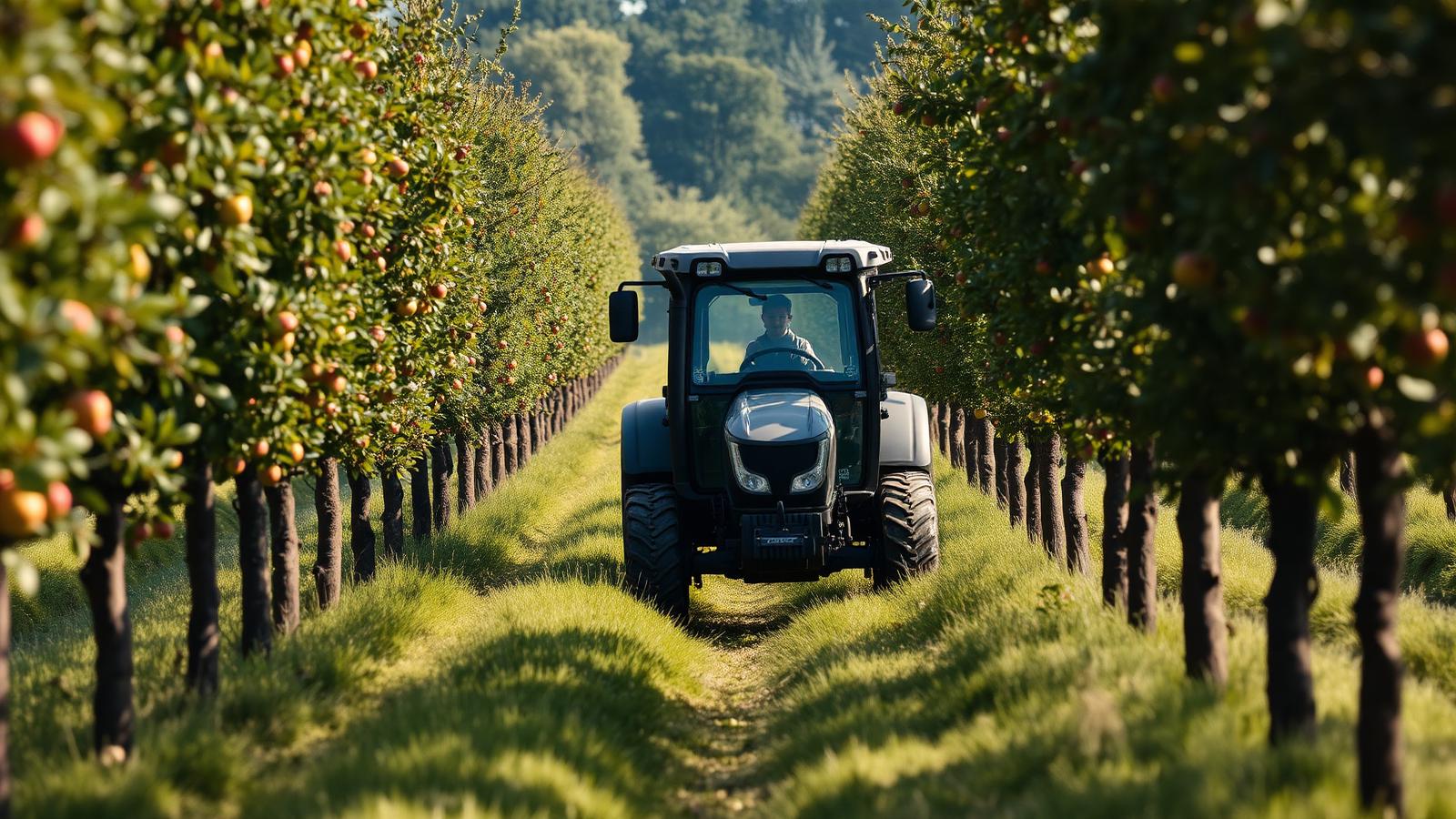
Two variants are described. The e100 Vario is aimed at broader utility, amenity, vegetable and livestock applications. The e107 V Vario is built for narrow working environments such as vineyards and orchards, with a minimum external width from 1.07 metres and a height of 2.45 metres. Both are supported through the Fendt UK dealer network, with technicians trained on the electric drivetrain.
Source: Crawfords Group, a Fendt dealer, August 2025.
Fendt e107S Vario
Farmers Weekly's Ultimate Guide to Buying a Tractor 2026 listed the Fendt e107S Vario as the first full-size tractor to appear in the guide.
The guide describes outputs of 68hp, 75hp and a time-limited 90hp to suit different applications and work scenarios, positioning the machine as an alternative to the diesel 207 S Vario. It reports a list price of near £200,000.
Source: Farmers Weekly, April 2026.
New Holland T4 Electric Power
New Holland lists a T4 Electric Power model within its UK agricultural tractor range.
Source: New Holland UK product pages, checked August 2026.
Compact and utility machines
A number of electric compact and ride-on tractors are sold in the UK through specialist dealers rather than the major agricultural networks. Knegt electric compacts, distributed by GGM Group, are one example.
These machines generally target groundcare, smallholding, amenity and light utility work rather than field cultivation.
Source: GGM Group, checked August 2026.
What do electric tractors cost in the UK?
Published list prices for battery-electric tractors are higher than for comparable diesel machines, and the gap is substantial rather than marginal.
The clearest published UK figure is the near £200,000 list price reported by Farmers Weekly for the Fendt e107S Vario in its 2026 tractor guide, against a machine positioned as an alternative to the diesel 207 S Vario.
Prices shown here are published list prices reported by the sources named, not quotes. What a buyer pays depends on specification, dealer, trade-in and finance. This site has not driven, tested or inspected any machine mentioned, holds no relationship with any manufacturer or dealer, and does not sell tractors.
A list price also tells you very little on its own. Charging equipment, any electrical supply work and the cost of the energy itself all sit outside it, which is why a whole-life view matters more than the headline figure.
Why are most available models compact or specialist?
The pattern follows the energy requirement rather than any limitation of electric motors themselves.
Battery packs store considerably less usable energy per unit of mass than diesel fuel. A machine doing long, high-load cultivation needs a great deal of stored energy, which means a very large and very expensive battery. A machine doing shorter, lighter, more predictable work near a yard needs far less.
That is why the available models cluster around orchard, vineyard, amenity, livestock, utility and groundcare duties. Those jobs have energy demands a sensibly sized battery can meet, and they often return to the same building every night where charging is straightforward.
It also explains why the first full-size machines to arrive are at the lower end of the full-size range rather than the top of it.
What is not yet available?
High-horsepower battery-electric tractors for sustained heavy cultivation are not a mainstream UK purchase option at the time of writing.
The used market is also immature. There are few machines, limited history on how their batteries have aged in agricultural service, and little settled evidence on residual values.
Neither point means the technology fails. It means the current UK choice is concentrated in a particular part of the market, and a buyer whose work sits outside that part has fewer realistic options.
How should you check what is current?
Model availability and pricing change faster than any article can track, so treat this page as a starting point and verify before committing.
- Check the manufacturer's UK site for the current model range rather than a general article.
- Contact an authorised dealer for current availability, specification and pricing in writing.
- Ask specifically whether the dealer has technicians trained on the high-voltage system and where the nearest one is based.
- Ask what the charging equipment costs and whether it is included in any quoted figure.
- Ask what the battery warranty covers, and whether a minimum retained capacity is guaranteed.