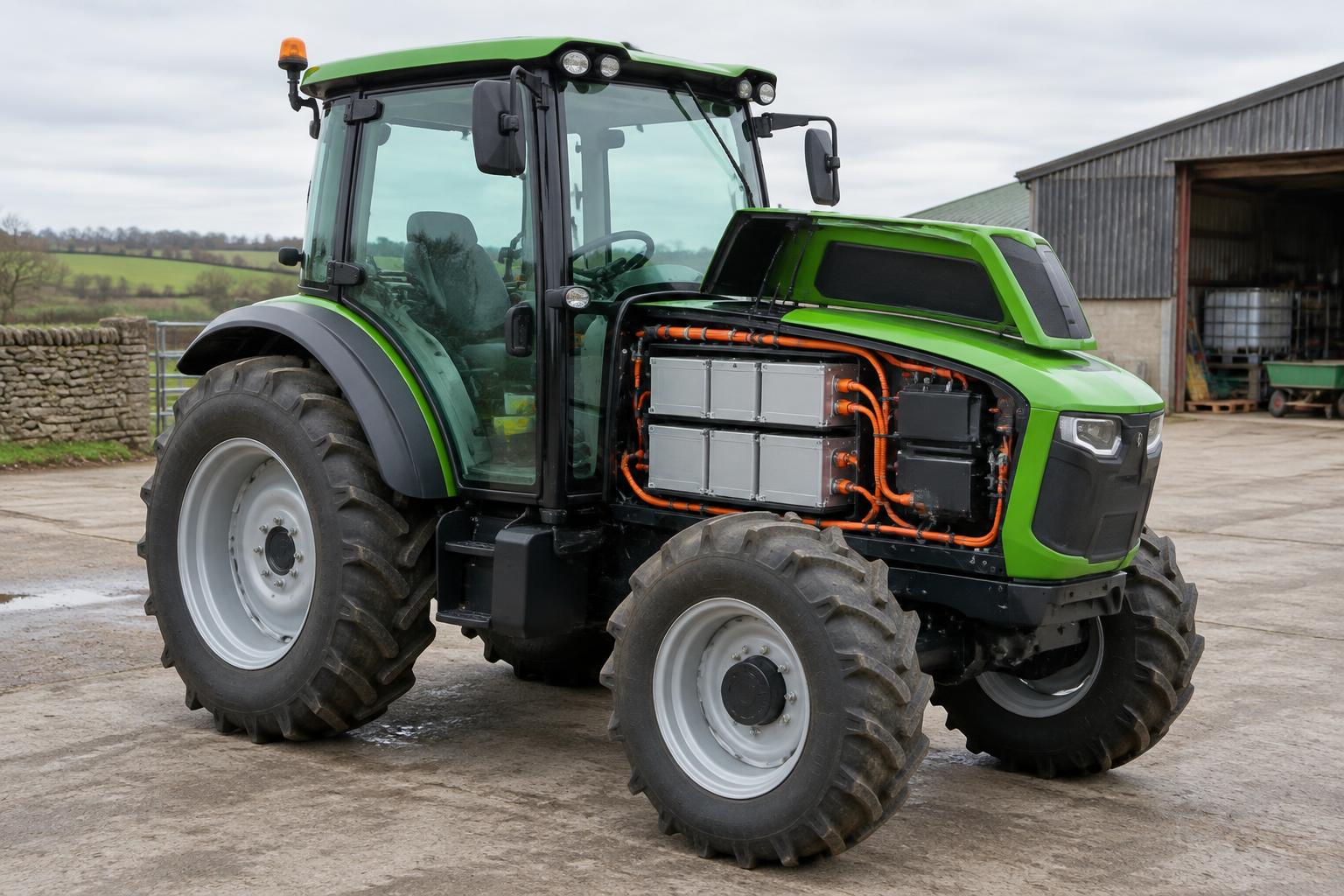
A battery-electric tractor works by storing electrical energy in a rechargeable battery and converting that energy into motion through an electric motor. Power electronics control how much energy reaches the motor, while other systems handle charging, cooling, hydraulics, implements and cab functions.
The principle is familiar from electric cars, but tractor duty is different. Agricultural machinery often operates at low speed under high load and may need to provide continuous power to an implement. That changes how the battery and drivetrain must be sized.
From the grid to the battery
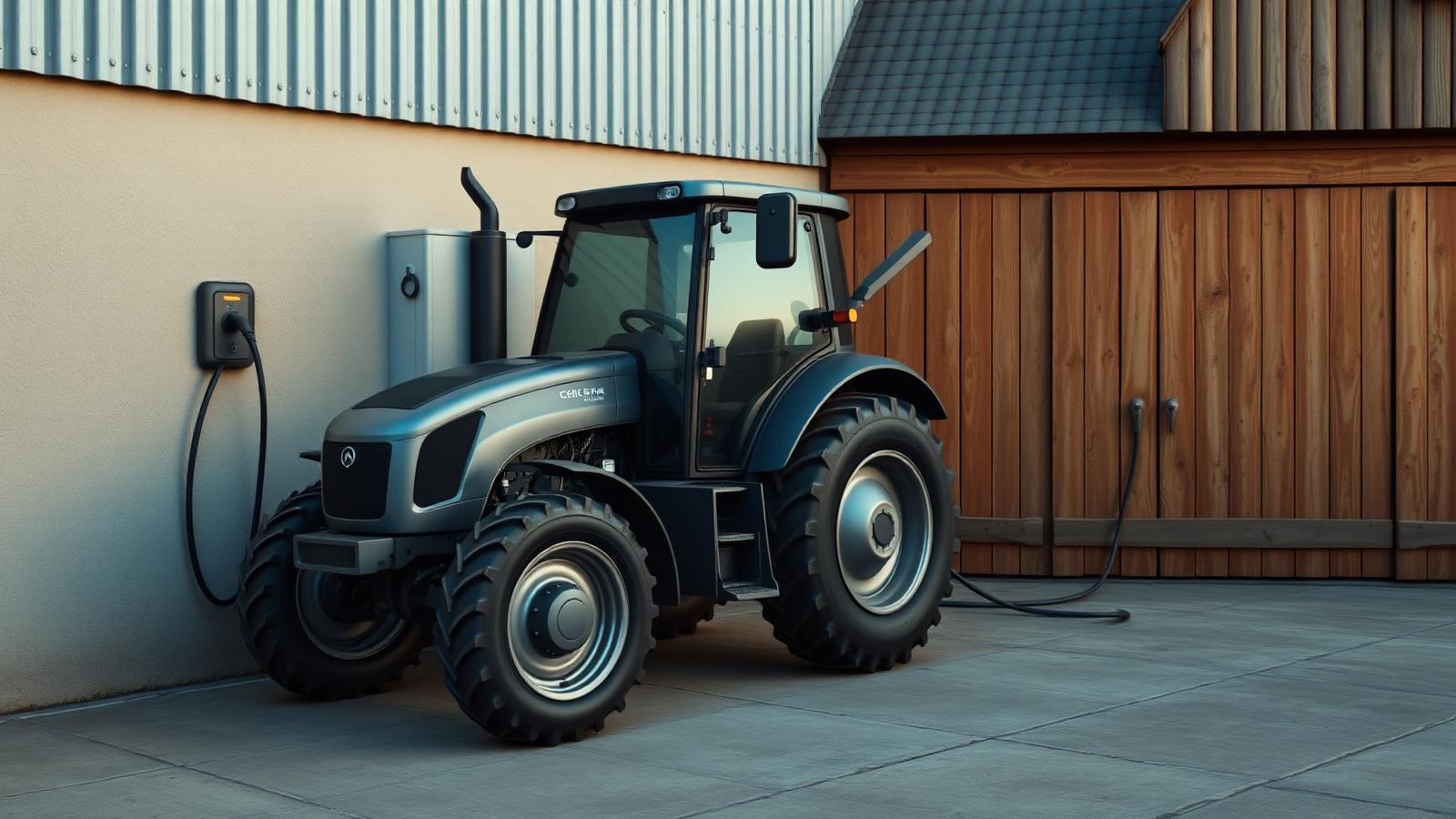
Charging begins with an electrical supply. The charger converts and controls power so the traction battery can be charged safely within limits set by the machine's battery-management system.
The battery-management system monitors factors such as state of charge, voltage and temperature. Modern high-energy batteries need careful control because charging too quickly, overheating or operating outside appropriate limits can affect performance, safety and long-term life.
Some charging is carried out with AC power, where conversion takes place onboard the tractor. Faster DC charging can bypass some onboard conversion and supply high-power DC to the battery through compatible equipment. Not every tractor supports both methods.
The battery is an energy store, not a power rating
Battery capacity is measured in kWh. Motor output is measured in kW or often still expressed as hp in tractor marketing.
Those figures describe different things.
A simple analogy is that battery capacity is the size of the energy store, while motor power describes how quickly the drivetrain can deliver work at a given moment. A large battery does not automatically mean a powerful tractor, and a powerful motor does not mean the tractor can run at full output for hours.
This distinction is essential when assessing electric tractor runtime.
What the inverter does
A traction inverter controls electrical power supplied to the motor. It can vary motor speed and torque rapidly and efficiently.
That gives electric drivetrains one of their useful characteristics: high controllability. Tractors often require precise low-speed movement, for example when manoeuvring, working around livestock or operating specialist equipment.
Electric motors also have a broad useful speed range. Designers can exploit that in different ways, either simplifying mechanical gearing or combining the motor with proven transmission technology.
How power reaches the wheels
There is no single electric-tractor layout.
One design may use a central motor connected to a conventional transmission. Another may use separate motors for different functions. Future machinery may electrify individual axles or implements more extensively.
The choice affects efficiency, cost, serviceability and how much existing tractor engineering can be retained.
For the user, the key point is that “electric” describes the energy source and drive technology, not necessarily every component between the motor and tyre.
Hydraulics still matter
Most working tractors rely heavily on hydraulics for linkage, steering, loaders and implements.
On an electric tractor, a hydraulic pump can be powered electrically and controlled according to demand. That can avoid wasting energy by driving a pump unnecessarily at all times.
However, hydraulic work still consumes energy. Repeated loader cycles or high-flow attachments can materially affect battery use. A buyer should consider hydraulic demand alongside traction and PTO load rather than thinking only about driving range.
How the PTO can work
Power take-off is another major part of tractor energy use.
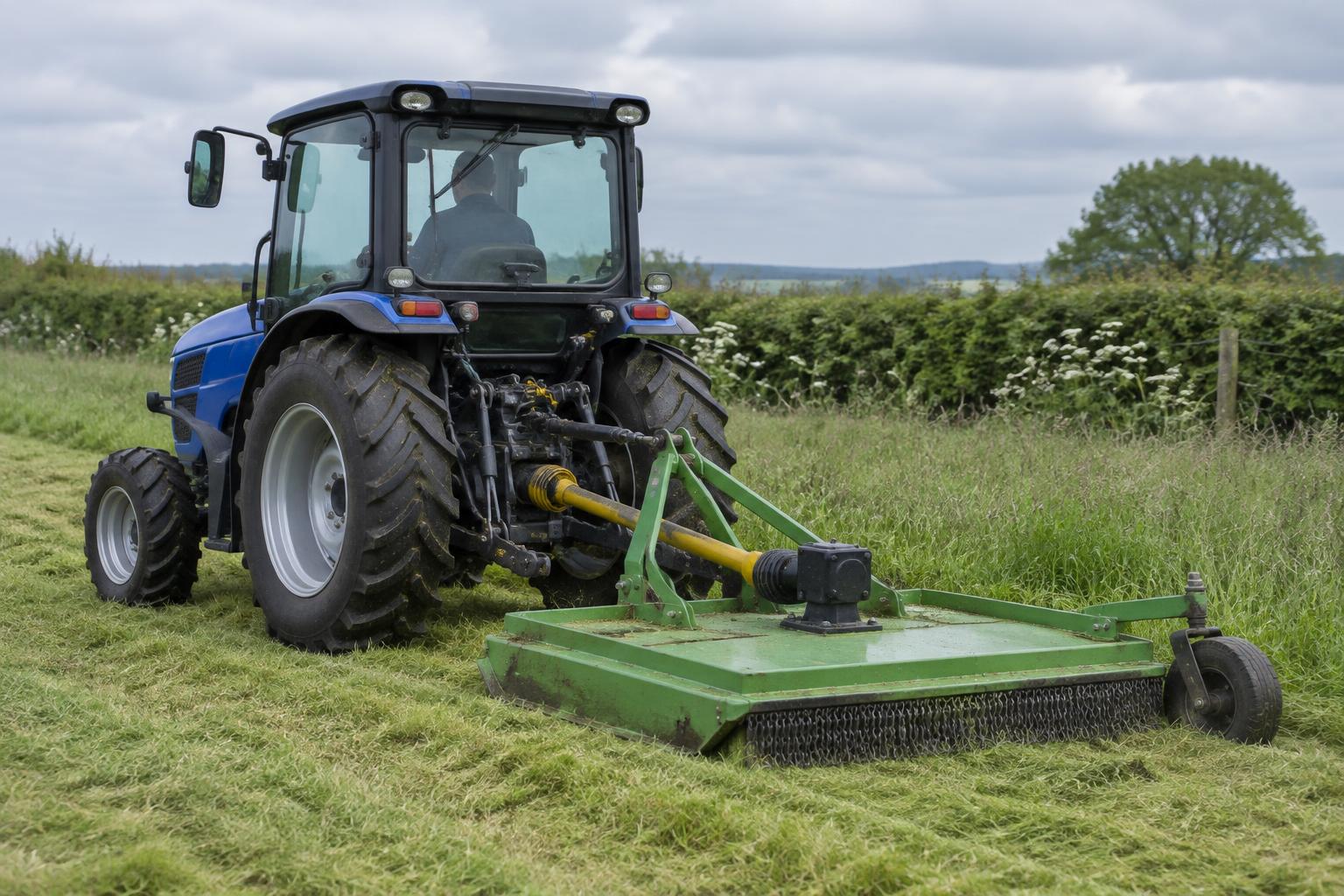
An electric tractor may provide a conventional mechanical PTO driven through the tractor drivetrain, or a design may use dedicated electrical drive. Whatever the method, the battery has to provide the energy.
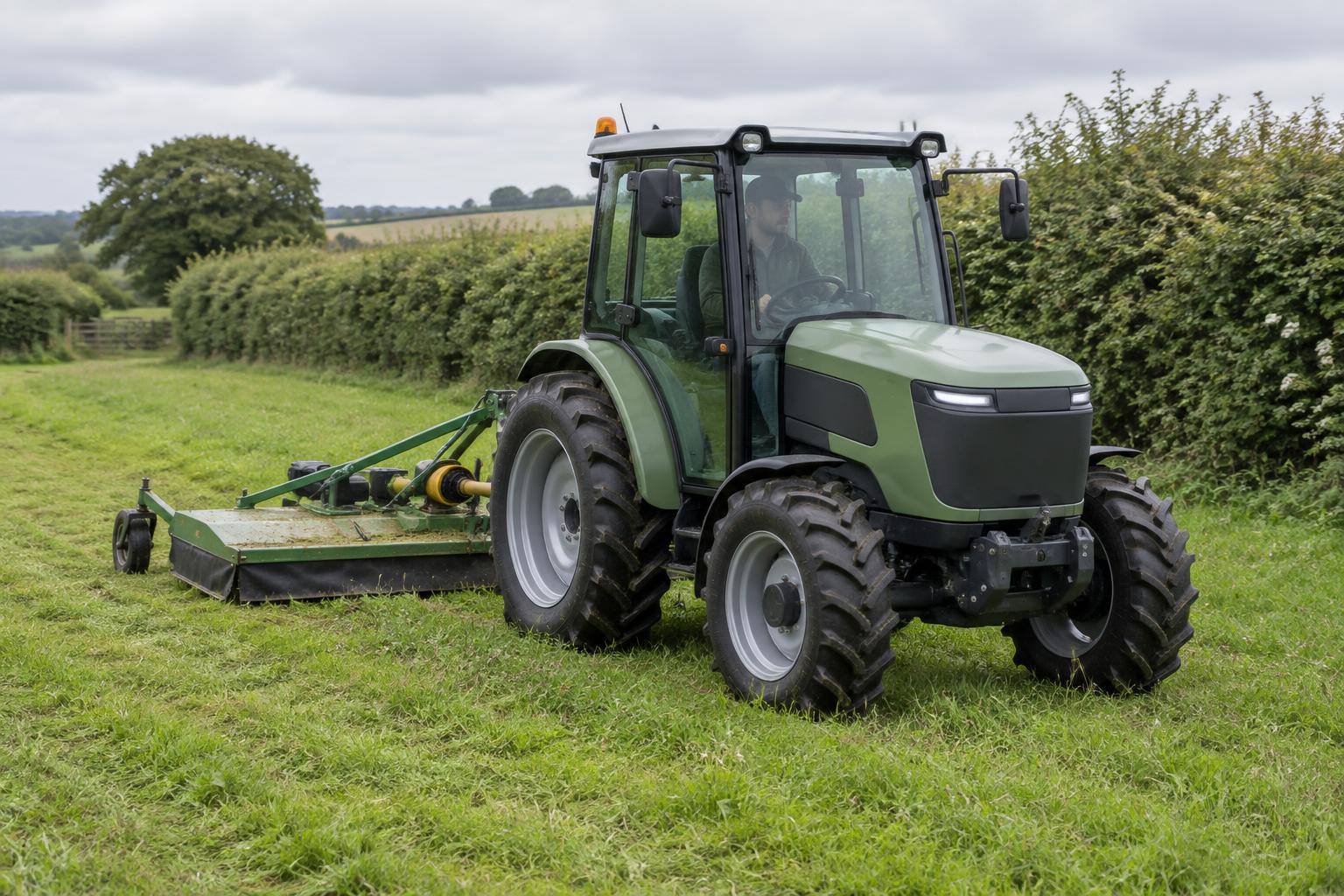
A mower, topper, baler, feed mixer or other PTO-driven implement can impose a sustained load that may be more demanding than simply moving the tractor.
That is why PTO and implement requirements are central to choosing a machine.
What happens when demand changes?
An electric powertrain responds quickly. When more torque is requested, the motor controller increases electrical power within the system's limits. When demand falls, power consumption can fall rapidly.
This can be particularly efficient in variable-duty work. A diesel engine may continue running even during periods of low useful output, whereas an electric system can reduce consumption when little power is required.
Not every agricultural task is variable, though. Heavy draft work can require sustained high output. That is where the amount of stored battery energy becomes more challenging.
Thermal management
Batteries, motors and power electronics perform best within designed temperature ranges. Electric tractors therefore need thermal-management systems, often using liquid cooling and control software.
Cold weather can reduce battery performance and increase energy used for heating. High temperatures and sustained loads can also require cooling.
This means weather and working conditions remain relevant even though there is no combustion engine.
Can electric tractors recover energy?
Electric vehicles can sometimes use regenerative braking, where the motor works as a generator during deceleration and sends energy back to the battery.
The potential benefit on a tractor depends on how it is used. Road transport or operation on gradients can present more opportunities than steady low-speed field work. Regeneration should therefore be seen as one efficiency tool rather than free energy.
The role of software
Electric tractors are also software-controlled machines. Battery management, motor control, charging, thermal management and energy-use displays depend on electronic systems.
That creates useful opportunities such as showing estimated remaining energy or scheduling charging, but it also makes diagnostics and software support important parts of ownership.
The key practical lesson
An electric tractor works as a connected energy system rather than simply a diesel tractor with the engine removed.
Battery, motor, hydraulics, PTO, charging, software and the farm's electrical supply all influence whether it can complete a working day. Understanding those connections is more useful than focusing on one headline specification.