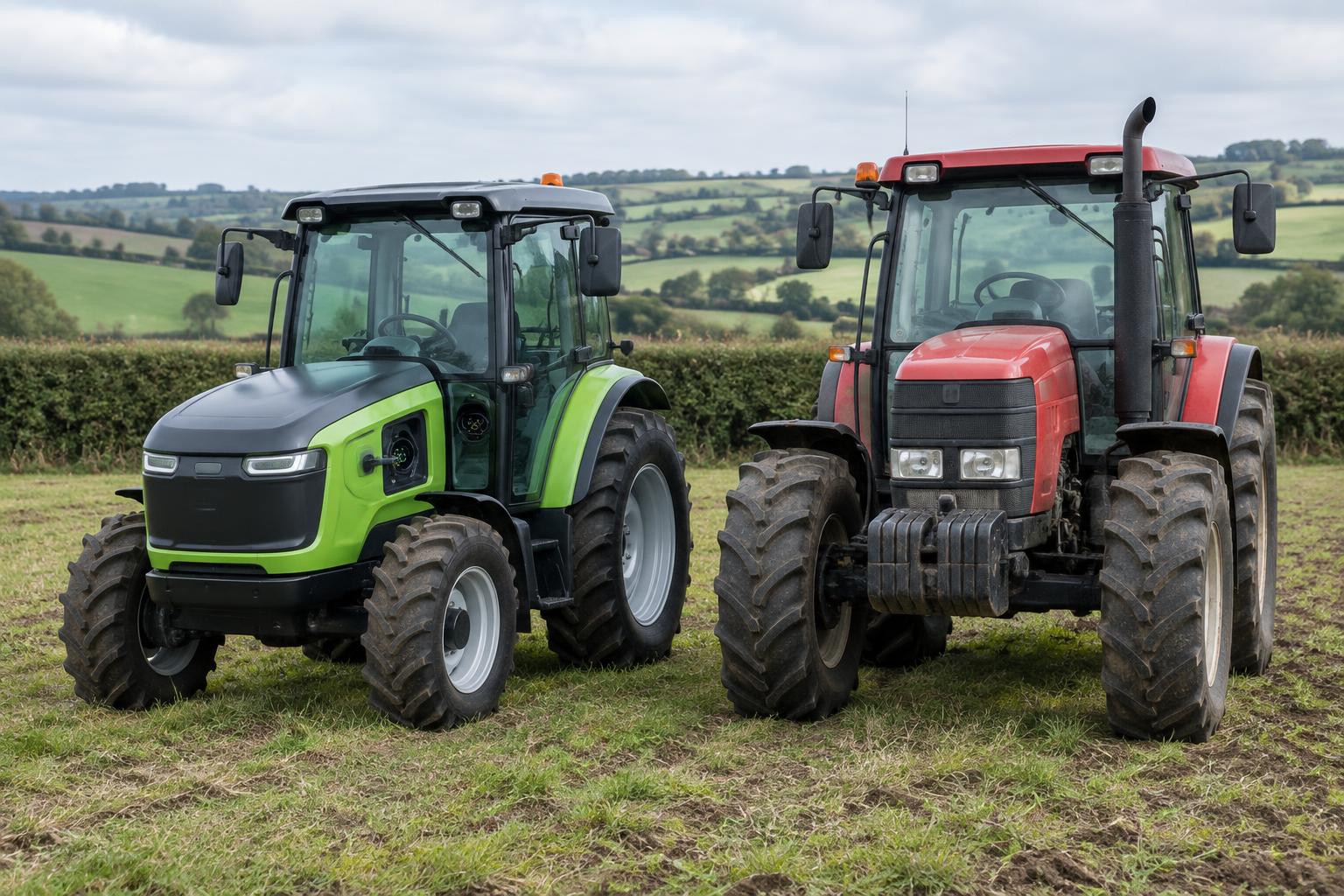
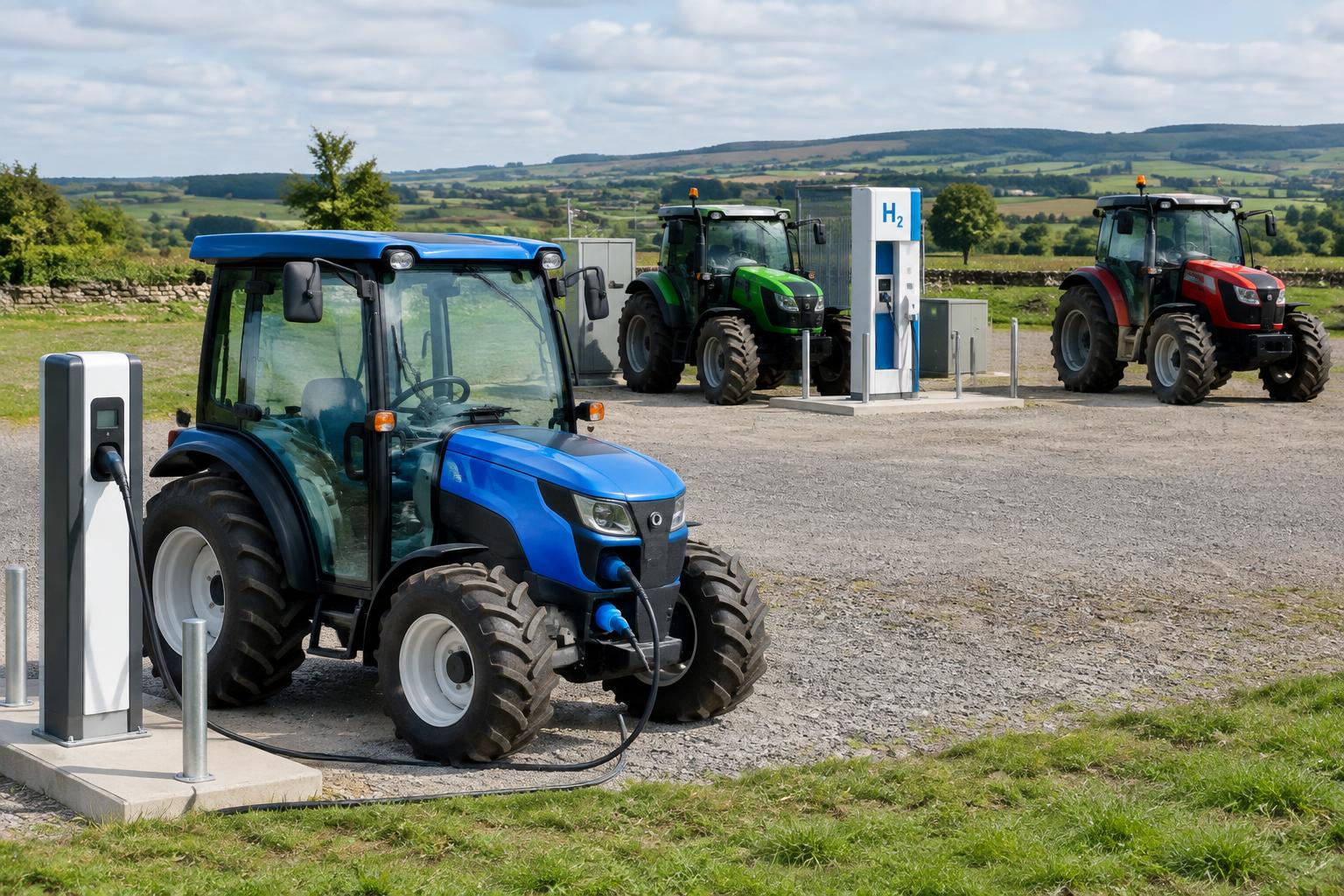
Battery-electric, hydrogen and hybrid tractors are all being explored as ways to reduce reliance on conventional diesel. None can be judged on one headline specification because each powertrain shifts the trade-offs between energy storage, efficiency, infrastructure, cost and operating time.
For agriculture, the likely result may be a mix rather than one technology winning every job.
Battery-electric tractors
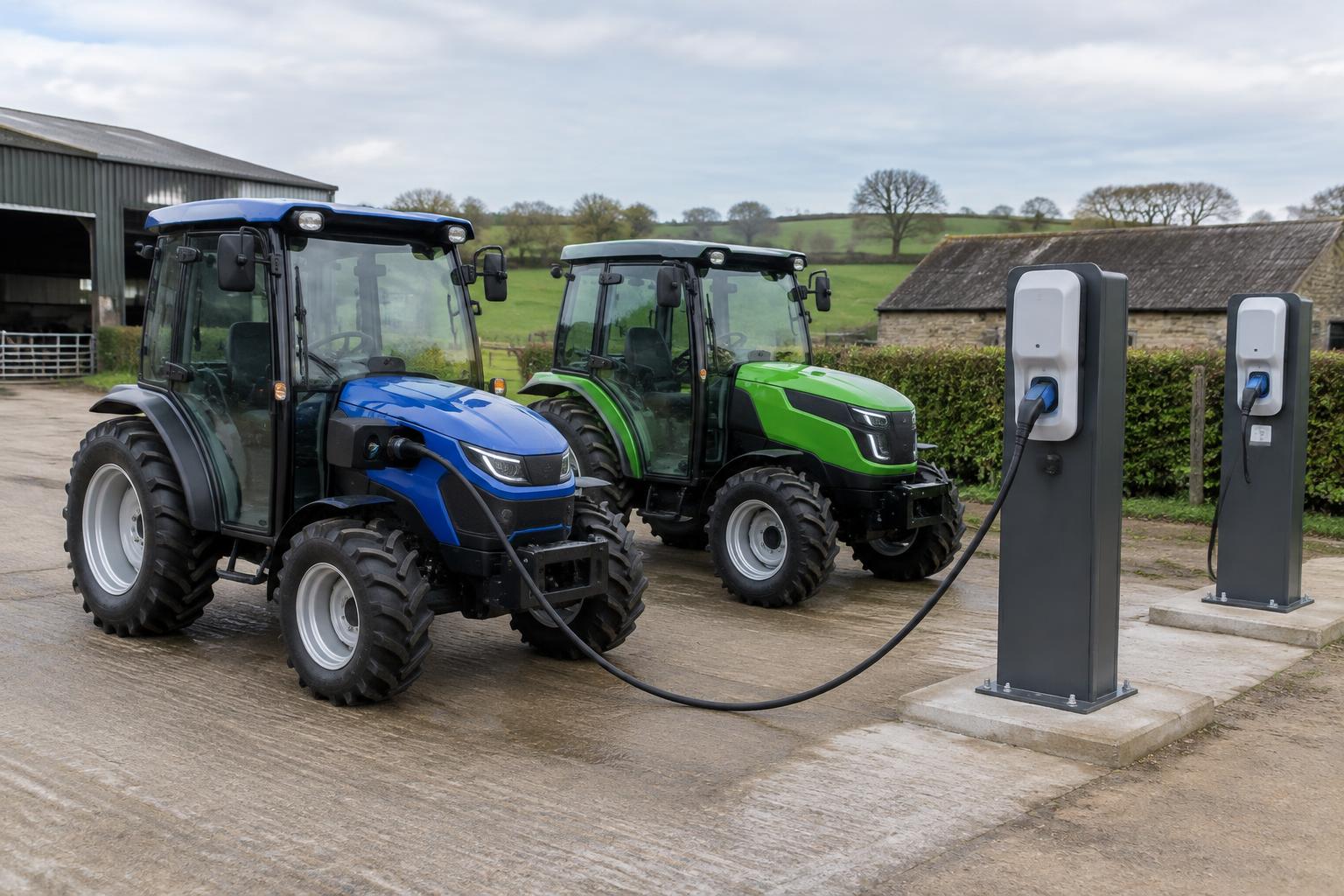
A battery-electric tractor stores electricity directly in a battery and uses electric motors for propulsion.
Its strengths include:
- high drivetrain efficiency;
- no tailpipe exhaust during operation;
- lower powertrain noise;
- precise motor control;
- ability to charge from grid or on-site generation;
- fewer combustion-engine service items.
Its main challenge is energy storage. Batteries are heavy relative to the amount of energy required for long high-load work.
Hydrogen fuel-cell tractors
A hydrogen fuel-cell vehicle stores hydrogen and converts it into electricity through a fuel cell, which then powers electric motors.
This can offer faster energy replenishment than large battery charging if suitable hydrogen refuelling exists.
The major problem is infrastructure and energy efficiency.
Hydrogen has to be produced, compressed or otherwise stored, transported and converted back into electricity. Each stage has losses.
For farms without a reliable hydrogen supply, the refuelling challenge can be greater than installing an electric charger.
Hydrogen combustion
Hydrogen can also be burned in an internal-combustion engine.
That retains more familiar engine technology but does not gain the full efficiency advantages of an electric drivetrain.
Combustion can also produce nitrogen oxides under some conditions, so “hydrogen” should not automatically be treated as zero-emission operation.
Hybrid tractors
A hybrid combines more than one energy source or powertrain element.
For example, an engine may generate or supplement electrical power while electric motors handle traction or auxiliaries.
The advantage is flexibility.
A smaller battery can provide efficient electric operation during suitable periods while the onboard fuel source extends working time.
The disadvantage is complexity because the machine carries both combustion and electrical systems.
Energy efficiency
Battery-electric systems generally have a direct energy path: electricity → battery → inverter → motor.
Hydrogen adds conversion stages: electricity or another energy source → hydrogen production → storage/distribution → fuel cell → electricity → motor.
That normally makes the battery route more energy-efficient where direct charging is practical.
Hydrogen's argument becomes stronger where storing and quickly replenishing very large amounts of energy is more important than conversion efficiency.
Refuelling and charging
A battery tractor can use widespread electrical infrastructure, but high-power charging may require site upgrades.
Hydrogen requires specialist production or delivery and refuelling equipment.
Hybrid tractors can refuel through existing liquid-fuel infrastructure where the combustion side uses an available fuel, while also benefiting from electrified functions.
The easiest infrastructure therefore depends on the farm and region.
Heavy-duty work
Long, high-load field work is the hardest area for battery-electric tractors because of the energy required.
Hydrogen or hybrid systems may offer greater onboard energy without an enormous battery.
However, machinery must still be commercially available, affordable and supported.
A theoretical advantage is not useful if fuel supply or service infrastructure does not exist.
Local emissions
Battery-electric tractors produce no tailpipe exhaust.
Hydrogen fuel cells mainly produce water at the point of use, although the lifecycle impact depends on how hydrogen is made.
Hybrid and hydrogen-combustion machines can still have tailpipe emissions depending on the engine and fuel.
Lifecycle analysis is therefore more useful than a simple “clean fuel” label.
Noise
Battery-electric and fuel-cell electric drivetrains can be quieter than combustion engines.
Hybrids may operate quietly in electric mode but still use an engine at other times.
Implements and tyres remain sources of noise for all three.
Maintenance
Battery electric removes many engine service items.
Fuel-cell systems add hydrogen storage and fuel-cell components that require specialist support.
Hybrids have both electrical and combustion systems, which can increase complexity.
Long-term maintenance data will become clearer as more machines enter real agricultural service.
On-farm renewable energy
Battery-electric tractors can directly use farm-generated electricity through the site's electrical system.
Producing hydrogen on farm is technically possible but requires additional equipment, energy, compression/storage and safety systems.
Whether that makes economic sense depends on scale and utilisation.
Which technology is likely to win?
For compact and predictable duties, battery electric has a strong technical case because it is efficient and charging can be straightforward.
For very high-energy duties, the market may continue exploring hybrids, alternative fuels, hydrogen and new battery strategies.
No buyer should assume one pathway will dominate every tractor category.
What should a farm buy today?
Buy the machine that exists, is supported and completes the required work economically.
Do not purchase a technology simply because it may become important in the future.
Likewise, do not dismiss battery electric because it cannot yet solve the hardest possible agricultural duty.
The practical conclusion
Battery electric is currently the most direct route from renewable electricity to tractor motion.
Hydrogen may offer advantages where rapid replenishment and high stored energy become critical, but infrastructure and efficiency are substantial challenges.
Hybrids trade some simplicity for flexibility.
Agriculture is varied enough that all three approaches may find niches. The real winner in each case will be the system that delivers reliable work at an acceptable whole-life cost.